
Multi-step AI agents that plan, execute, and monitor complex tasks autonomously — with humans in the loop when it matters. Built for the work that takes more than one prompt.

.png)
.png)
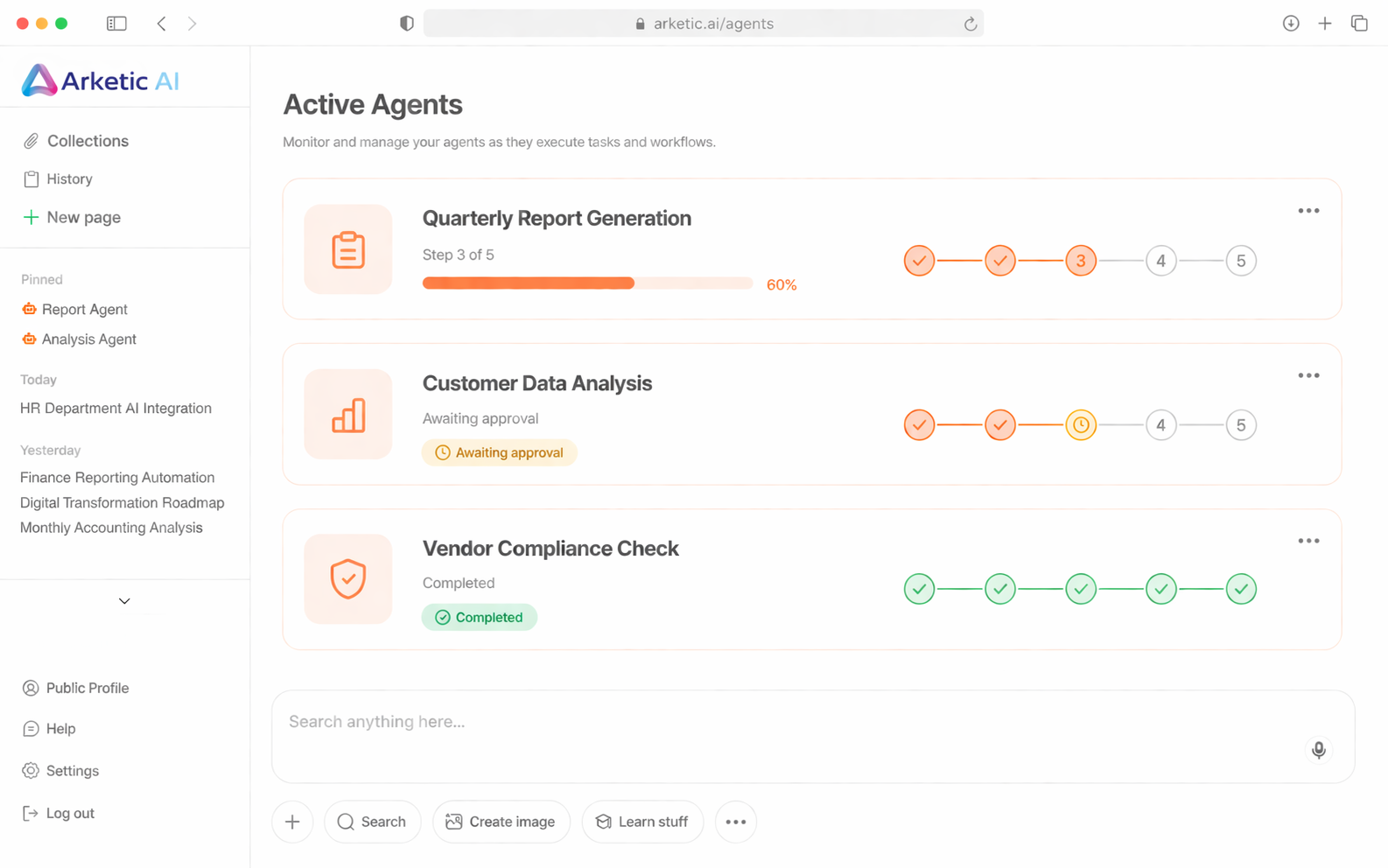
Agents break complex requests into clear steps, decide what to do first, and show you the plan before execution. No black-box reasoning — every step is visible, traceable, and editable. From quarterly report generation to customer onboarding, the agent maps the work, then does it.
.png)
Agents pause for approval before sensitive actions: sending external emails, modifying records, executing financial transactions, or accessing restricted data. You define the boundaries — the agent respects them. When stakes are low, the agent moves fast. When stakes are high, your team decides.
.png)
.png)
.png)
Agents don't just talk — they take action across your real systems. Pull data from SAP, update records in Salesforce, create tickets in Jira, send messages in Slack, query databases, and trigger workflows. Each tool call is logged, each output traceable. Your agent works where your team already works.



Assistants respond — they answer questions, draft replies, and have conversations. Agents act — they take a goal, plan multiple steps, execute across systems, and monitor results until the task is done. Assistants are great for support and information; agents are built for work that takes more than one prompt.
Your IT team configures the agent's goal, defines which tools and systems it can access, sets approval rules for sensitive actions, and chooses which departments can deploy it. Initial setup typically takes a day or two for a new use case. If you'd rather not handle the configuration, our team can deploy it for you on request — usually within a few business days.
Agents are designed with multiple safeguards. Human approval is required before any sensitive action, every step is logged with full context, and you can pause, modify, or roll back execution at any time. If something goes wrong, the audit trail shows exactly what happened, why, and which approval allowed it — so issues are diagnosable, not invisible.
You choose. Agents can run on-premise, in your private cloud, or in a hybrid setup. Sensitive operations stay within your infrastructure using your on-premise Arke LLM, while general tasks can use frontier models like Claude or GPT — all from one orchestration layer. Data never leaves the boundary you define.
es. You can deploy unlimited agents in parallel — each with its own goals, permissions, and tool access. Finance, Operations, HR, and IT can run their own agents independently. Agents can also collaborate on shared workflows when configured to do so, with clear handoffs and audit trails between them.

%20(184%20x%2044%20piksel).svg)