
A major international logistics company operating hundreds of trucks across Turkey and Europe transformed its fragmented driver communication into structured, AI-powered workflows. Discover how Arketic AI turned WhatsApp messages into automated operational actions — from multilingual message analysis to cross-border compliance tracking.
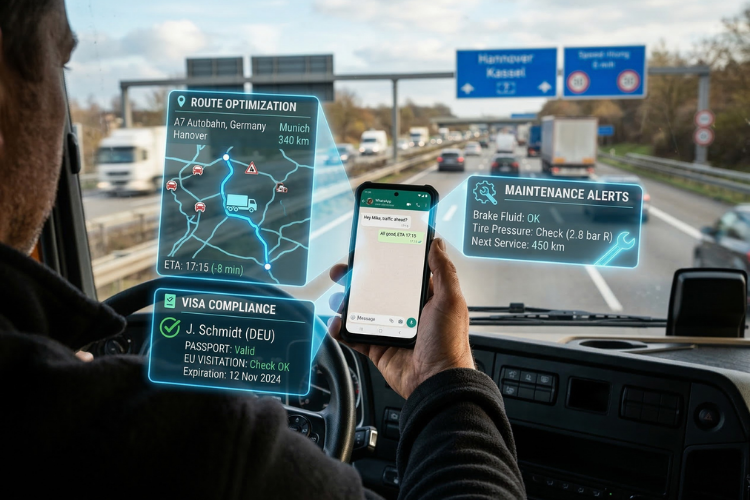
A major international logistics and transportation company operates a large fleet of trucks across Turkey and Europe, providing cross-border freight services under strict operational, legal, and time constraints. With hundreds of drivers on the road daily, the company manages complex logistics involving vehicle availability, driver coordination, regulatory compliance, and real-time operational issue handling.
The company faced operational challenges common to large, geographically distributed logistics fleets, where drivers must report to multiple entities depending on their real-time location.
Inefficient Driver-Headquarters Communication: Drivers frequently encountered issues such as truck breakdowns, load-related problems, and route or border delays. However, drivers are often not IT-savvy and would struggle with structured reporting or dedicated mobile applications. Some drive across borders requiring very low data transmission, sometimes precluding continuous online connectivity. Building specific applications for multiple platforms would require not only significant development time but also considerable training effort. Communication via email, phone calls, or ad-hoc messages led to lost information, delayed responses, and inconsistent escalation to the correct operations center.
Multilingual and Unstructured Information: Drivers communicated in different languages, dialects, and informal expressions. Issues were often reported via free-text messages or photos of damaged tires, vehicle issues, or documents. Manual interpretation within the command chain slowed response times and increased error risk.
Cross-Border Compliance Complexity: Drivers crossing borders required constant checks for visa validity, driving and rest regulations, and truck-related permits and documents. These checks were largely manual, reactive, and prone to delays.
Fragmented HR and Operations Data: Time sheets, border crossings, and driver status updates were not automatically synchronized with HR systems. Department heads were often notified too late about compliance or staffing risks.
The company implemented Arketic AI's logistics communication system, integrated with the internal HR system, delivering the following core capabilities:
Intelligent Message Analysis: AI ingests WhatsApp messages from drivers, analyzing them and attributing them to the relevant chain of command, whether HR or logistics, and based on geography. If information supplied by a driver seems inadequate, the system automatically asks follow-up questions in the driver's language. AI analysis uses natural language processing (multilingual), image analysis for truck damage, paperwork, and cargo, and converts unstructured driver input into structured operational requests. The system informs and automates actions in the chain of command, alerting relevant parties to any anomalies in the situation such as delays or geographic inconsistencies.
Human-in-the-Loop Automated Flow Engine: AI proposes next actions such as roadside assistance, rescheduling, or documentation checks. Human approval is requested before critical steps are executed, ensuring operational control, accountability, and regulatory safety.
Cross-Border Time, Visa, and Permit Intelligence: Arketic AI continuously checks driver vacation and rest-time limits, visa expiration dates for both driver and vehicle, and country-specific compliance rules. The system automatically feeds time sheets into HR systems, alerts department heads of risks or upcoming expirations, and flags urgent visa or permit renewals before violations occur.
The solution works through multiple integrated sub-services. While the request analysis component provides a foundation for two-way driver communication, it also informs the chain of command through a highly specialized flow engine integrated with the company's HR system.
Logistics issues are domain-specific and, due to certain regulatory aspects, cannot always be disclosed to cloud-based AI providers. Additionally, competitive sensitivity around track records of drivers, trucks, and cargo requires careful data handling. Proper decision-making often demands analysis of this sensitive data, a task that is challenging for the traditional command chain.
Arketic AI's integration capabilities are extensive, incorporating company-specific data and HR applications, thereby providing a complete solution running on a platform as widely used as WhatsApp.
Arketic AI's operations engine parses and optimizes process information to and from drivers at a fraction of the time previously required. Depending on the complexity and availability of information, processing that once took hours now takes minutes, representing up to a 100x improvement in response time.
Daily compliance checks for regulations based on visa requirements and truck or trailer specifications, which previously consumed hours of staff time, now take minutes. Unlike traditional RPA approaches that require pre-defined rule sets and anomaly models, Arketic AI makes decisions on the fly with final human approval, adapting to new situations without requiring reconfiguration.
Following the highly successful implementation, future plans include: predictive breakdown analytics to anticipate truck failures before they occur using historical data and images; dynamic route and border risk scoring to predict delays based on border congestion, weather, or regulatory changes; automated document validation using AI-based OCR for customs and transport documents; driver performance and safety analytics combining incident data with driving patterns for coaching and safety improvements; and integration with insurance and roadside services for automatic claim initiation and service coordination.
Additional implementations are planned for standard HR, financial, and industry-imposed standards adherence and reporting cycles across the organization.
Conventional solutions typically fall into one of the following categories: acting as a hub for one or multiple AI solutions; using external robotic engines to automate flows once AI output is generated; or requiring expert AI engineers to tune and integrate into existing environments.
Arketic AI stands apart by enabling organizations to incorporate their sensitive existing data without disclosing it to third-party cloud providers. AI decisions rely not only on publicly available web data but also on the company's own proprietary data, all without sending sensitive information outbound.
Architecturally, Arketic AI can function on-premises or in Arketic's own cloud data center, fully compliant with local and national regulations for holding sensitive customer data.
With its integrated automation engine, Arketic AI enables seamless flow of AI-generated outputs without the need for any external third-party toolset. And through its agent creation engine with straightforward tutorials, users can create their own agents without requiring Arketic professional services.
%20(184%20x%2044%20piksel).svg)